According to observers, the case of former National Assembly Deputy Nguyen Sy Cuong—who avoided criminal liability in a fatal traffic accident in Hanoi in late May 2025—would have been nothing more than a criminal case closed in the police files had it not been for the strange developments that continued for more than 14 months afterward.
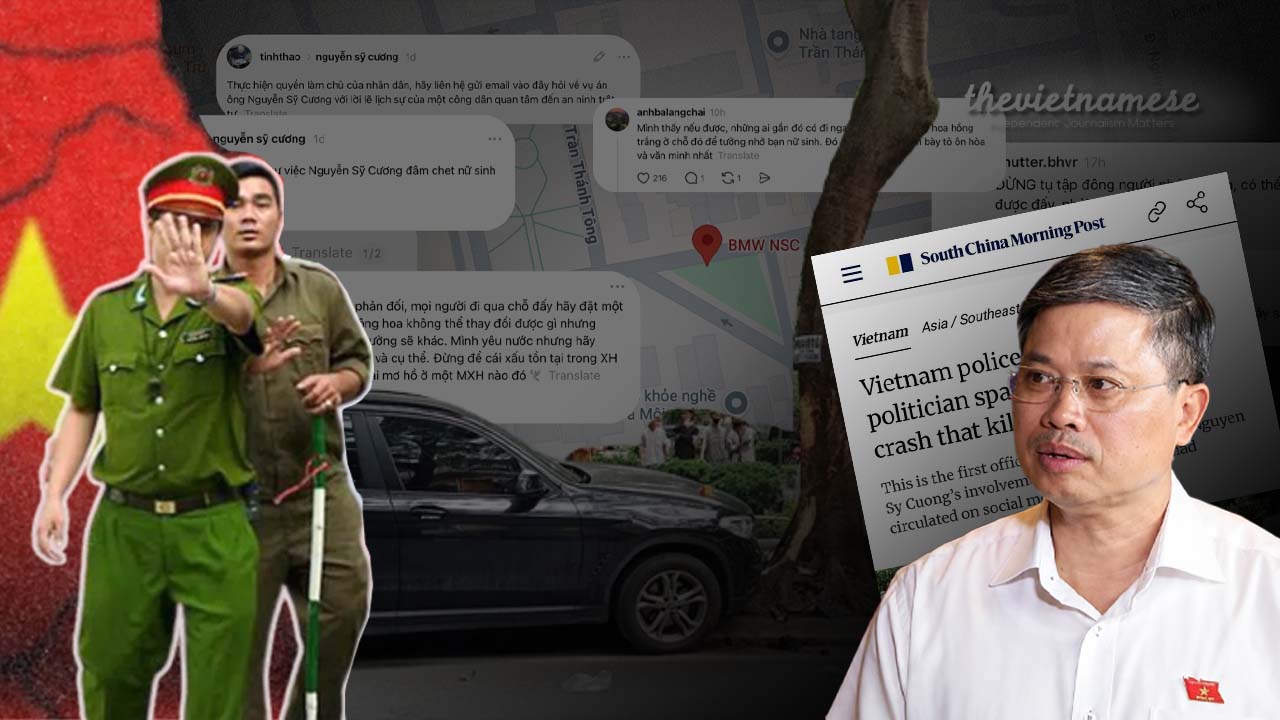
When Reuters, AFP, The New York Times, and many other international news agencies simultaneously featured this case in their top international news reports, the story officially transcended the boundaries of an ordinary criminal case.
The involvement of international news agencies served as a magnifying glass, transforming a traffic accident into a reflection of societal trust and the functioning of Vietnam’s legal system regarding truth and justice.
Notably, these news agencies did not act as a court to judge whether Mr. Cuong was guilty or to determine whether the authorities’ decision to exempt him from criminal liability was right or wrong. However, they have documented and exposed the gap between the legal issue and the deeply troubling real-world reaction from the Vietnamese public.
According to Reuters, the effort to verify video footage showing Hanoi law enforcement preventing young people from laying flowers at the scene—or plainclothes police officers tailing foreign journalists—highlighted the gravity of the situation.
Thus, the nature of the story has shifted from baseless rumors on social media to compelling, firsthand accounts that are highly persuasive to the international community.
According to Reuters, the initial prolonged silence, combined with the special political standing of Mr. Cuong—the person responsible for the accident—created a significant information vacuum that no warning about “hostile forces” from the Vietnamese government could fully fill.
Whether viewing this issue through the lens of Gen Z youth or through analyses aimed at maintaining social order, the Vietnamese government often hastily labels such discontent as the result of exploitation or incitement by reactionary elements.
However, this line of reasoning overlooks a fundamental, natural premise: skepticism never arises spontaneously in a transparent social environment. When information is doled out sparingly and the government’s control measures reveal its anxiety, social media naturally becomes a substitute court of public opinion.
The core question raised by the public and the international press is not whether Mr. Cuong was actually acting within the law when the victim’s family withdrew their complaint. Rather, it is whether an ordinary citizen would receive similar leniency if they caused a fatal traffic accident of that nature.
The government’s silence in the face of demands for equality before the law is precisely what fuels the pent-up resentment in society—a resentment that no administrative order from the state can possibly quell.
The international media’s comparison of a series of events—from the leadership’s stance, fatal accidents, or mitigating circumstances… to the fierce backlash from the youth and the political warnings that any government must reflect upon—is telling.
They do not need to steer public opinion; the very inequality in how the situation was handled and the security cordon surrounding the “tree of justice” at No. 55 Nguyen Huy Tu Street speak for themselves.
When a bouquet of flowers left by the roadside in the heart of Hanoi can become a topic in global news reports, the issue is no longer simply a matter of internal security, but a test of Vietnam’s credibility on the international stage.
According to analysts, to completely eliminate the loopholes that “bad actors” could exploit, the solution has never been to tighten information controls or label people as “reactionaries,” but rather to ensure that justice is equally accessible to everyone.
Tra My – Thoibao.de