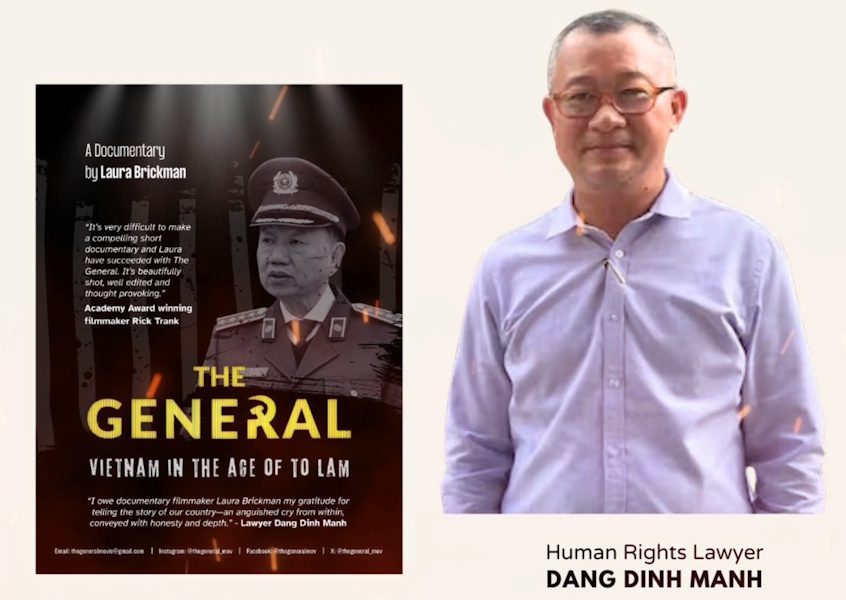
Reflections by human rights lawyer Đặng Đình Mạnh after watching the film in Washington, D.C.
I never thought I could be moved by documentary films—until I watched The General, a documentary by American director Laura Brickman. It changed my mind. I was deeply moved, and even when I was invited to speak about the film immediately afterward, my voice was still choked with emotion.
Because in just the first few dozen seconds, memories of Vietnamese society—memories I thought had been asleep for more than two years since I escaped Vietnam—came rushing back almost in full. They were vivid. Fresh. So much so that it felt as though everything had happened only yesterday.
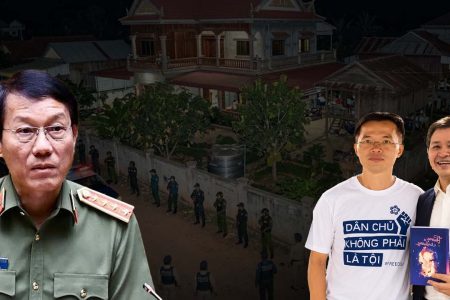
Like young security men tailing people without bothering to hide their faces; police breaking locks and storming into citizens’ homes to make arrests; plainclothes agents openly assaulting people in the street—even when the victim is nothing more than a physically fragile young woman…
In the film, I “met again” faces of whom nine out of ten were my clients. Each had a different life, a different fate. Yet they share one proud common point: the harshness they are forced to endure simply because they spoke up, because they struggled for dignity and for the good values demanded by the conscience of a nation.
The documentary The General passes quickly. From dozens of seemingly disconnected stories, the film weaves them into an extraordinarily coherent whole, skillfully telling the story of our suffering country in this dark and bleak period.
It opens with the line: “He’s watching us. Yes—right on your right.” The camera pans quickly and stops on a young man riding a motorbike, one hand on the handlebars, the other brazenly pointing a mobile phone camera straight at us…
Cut. Outside, a group of police and neighborhood militia stride aggressively toward a locked iron gate, carrying a huge pair of bolt cutters. Inside, Trịnh Bá Phương’s voice remains gentle and calm: “…as I have written in my will, I have no intention of committing suicide if I am arrested…”
Cut. A girl is walking along the road. The cameraman follows and says, “I hope to walk with you for a part of the way…” Then a young man rushes up from behind, hastily kicks down the kickstand of his motorbike, strides past, and slaps her hard on the head, sending her sprawling sideways…
The screen turns white. Everything seems to settle. Then a soft melody begins, each lyric drifting slowly and plainly: “Sài Gòn is so beautiful”:
“Stopping on the wharf as the sun has not yet faded,
From afar, countless fluttering dresses appear,
A cheerful way of life draws footsteps here,
Sài Gòn is so beautiful—Sài Gòn, oh Sài Gòn! Sài Gòn, oh Sài Gòn!”
The rhythm continues unhurriedly, and the screen shows helicopters dragging the red flag with a yellow star, clouding the clear blue sky. Columns of soldiers carry rifles with bayonets pointed forward, marching in step past the reviewing stand; rows of cannons fire into the air, filling it with thick smoke. Mixed among them are even kindergarten-age children dressed in soldiers’ uniforms as if to strip away their innocence.
This cinematic device—the sharp contrast between images of the “troops liberating Sài Gòn,” as the Communist regime so often boasts, set against the simple, rustic song about a “beautiful Sài Gòn”—serves as an opening, laden with implication, to The General.
Faces appear one after another: Phạm Đoan Trang, Trịnh Bá Phương, Trịnh Bá Tư, Cấn Thị Thêu, Lê Đình Lượng, Nguyễn Năng Tĩnh, Phạm Chí Dũng, Lê Hữu Minh Tuấn, Bùi Tuấn Lâm, Dương Tuấn Ngọc, Nguyễn Văn Đài, Trần Thị Tuyết Diệu, Y Quynh BDap, Trần Đức Thạch, Y Krech Bya, Ngô Thị Tố Nhiên, Nguyễn Tường Thụy, Đinh Thị Thu Thủy, Nguyễn Trung Tôn, Đường Văn Thái, Trương Văn Dũng, Nguyễn Thị Cẩm Thúy, Ngô Thị Hà Phương… representing nearly 200 political prisoners featured in the film.
I still remember, during my years practicing law, being shaken to the core when I witnessed people like Cấn Thị Thêu and Trịnh Bá Tư calmly state their identity in court: “My name is: victim of the Communist regime.”
Or Trịnh Thị Thảo (Ms. Cấn Thị Thêu’s daughter), raising her small fist and shouting “Down with the Communists,” “Down with the Communists—cowardly before the enemy, cruel to the people,” right in the courtroom. And that fist kept rising with her cries all the way out to the yard, to the courthouse gate, packed with Communist security forces standing in dense clusters both inside and out.
Or Lưu Văn Vịnh, Nguyễn Văn Đức Độ, Nguyễn Quốc Hoàn, and Từ Công Nghĩa shouting in unison “Down with the Communists,” shaking the whole courtroom, drowning out the presiding judge’s sentencing words beneath those indignant yet unbreakably steadfast cries.
This time, through The General, I shuddered once more at the scene of Bùi Tuấn Lâm being escorted by police out to his gate, his hands cuffed—yet his handsome face wearing a slight, defiant smile, full of courage… He was almost my client: I had only just completed the procedures to defend him when I myself had to flee.
Before viewers have a chance to tip their hats to Lâm’s defiant smile—Lâm, the “scallion-sprinkling saint”—The General does not forget to recall the footage of “Salt Bae,” feeding gold-leaf steak to Tô Lâm during his trip to the United Kingdom—footage that once sent the name of the Minister of Public Security around the world, before he later became today’s General Secretary.
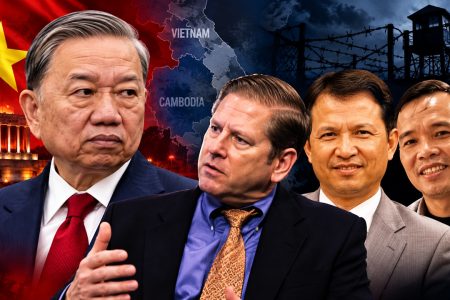
Events such as the kidnapping operation of Trịnh Xuân Thanh in Berlin—personally directed by Tô Lâm, using a Slovak aircraft; or Slovakia’s criminal investigation of Tô Lâm and seven other officials; the Formosa disaster… are all touched upon in the film.
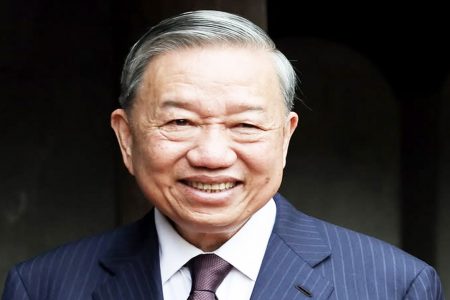
As for The General, even its promotional poster is striking: a black-and-white photograph of Tô Lâm in the uniform of a full general—an extremely telling detail, even before the audience sits down in front of the screen.
Looking at that image, a small number of people hastily guessed this might be a film “polishing” Tô Lâm’s reputation. But in that very realism, the poster designer cleverly frames him in a full-general uniform much like other dictators once seen around the world in the same kind of portrait—Hitler, Mussolini, Stalin, Pinochet… at the height of their power, and whose fates we all know.
Moreover, by choosing black-and-white instead of color, the image casts Tô Lâm as the type of authoritarian leader from a past that the civilized world has long since discarded into history’s trash bin. Only a few remain—rare, but hardly precious—still despised by their own people, such as Putin, Xi Jinping, Kim Jong Un, or Tô Lâm.
In short, The General is a film well worth watching. For Vietnamese people inside the country, it tells the story of their present suffering. For Vietnamese living overseas, it is even more worth seeing, at least:
-
To understand how fortunate you are not to live under a Communist dictatorship;
-
And to understand how painfully our compatriots at home are forced to live.
So that when the opportunity arises, we may extend a hand to help our fellow Vietnamese escape that hardship—so that all Vietnamese can live with the dignity that overseas Vietnamese are able to enjoy.
Finally, I regret that director Laura Brickman had other commitments and could not attend the premiere, because I believe I owe her a word of thanks—for telling the story of our country like a stifled cry from within, in a way that is so truthful.
Đặng Đình Mạnh
https://www.facebook.com/manhdang001